
What is entity SEO, and how do you do it?
Entity SEO makes sure search engines and AI systems recognize your business as one clear thing with known facts. This guide covers the four steps and a real consistency fix.
Key points
- An entity is a specific thing search engines can identify: a business, a person, a place, a product or a concept.
- Entity SEO makes sure search engines and AI systems recognize your business as one clear entity and connect it to the right topics.
- It has four parts: define the entity, describe it on your site, connect it with structured data, and confirm it with matching facts elsewhere on the web.
- Conflicting facts, such as two addresses or two founding years in different places, weaken the entity.
- It is the foundation of being named in AI answers, not only of ranking in search.
What is entity SEO?
Entity SEO is the practice of making a business, and the people and topics connected to it, clearly identifiable to search engines. Instead of optimizing a page for a phrase, it makes sure Google understands that a business is one specific thing, with known facts and known relationships: who runs it, where it operates, what it offers and what it is an authority on.
Search engines store entities and the links between them in knowledge graphs. A business that is a well-defined entity is easier to rank, easier to show in a Knowledge Panel and easier for AI assistants to name with confidence. It is one of the five parts of semantic SEO.
How do you do entity SEO?
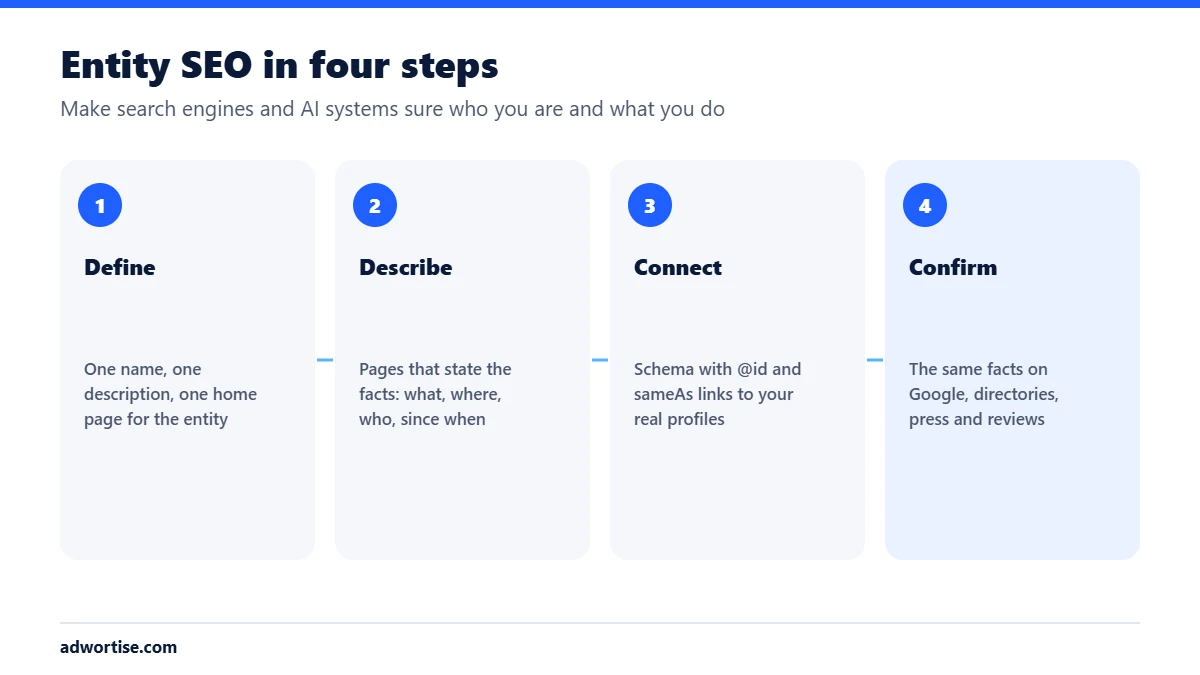
- Define the entity. Decide the exact name, a one-sentence description and the page that represents the business, usually the home page or About page. Use them the same way everywhere.
- Describe it on your site. State the facts plainly in text: what the business does, where it is, when it was founded, who founded it and who works there. An About page and a Team page with real names do much of this work.
- Connect it with structured data. Use Organization or LocalBusiness schema markup with a fixed @id, link the founders and authors as Person entities, and list your real profiles in sameAs: Google Business Profile, LinkedIn, social accounts, directory listings.
- Confirm it elsewhere. Make the same facts appear on your Business Profile, directories, social profiles, press mentions and review sites. Search engines trust facts that agree across independent sources.
- Connect it to topics. Publish content that shows what the entity knows: guides, research and case studies on the topics you want to be known for, written by named people.
What does inconsistent entity data look like?
When we reviewed our own business, the facts about Adwortise did not agree. The website, two directories and the Business Profiles listed different head office cities, different founding years and very different team sizes. To a search engine, those could be three different companies.
| Fact | Before | After |
|---|---|---|
| Head office | Three different cities across the site and directories | Karachi head office and London office, everywhere |
| Founded | Two different years | One year, on the site and in schema |
| Team | Sample names and three different team sizes | Real named team, linked as Person entities |
| Structured data | Organization with no address, founder or profiles | Organization with offices, founders, contact points and sameAs |
The fix was not clever. It was making one set of facts true everywhere, starting with the site and then the listings.
Why does entity SEO matter for AI search?
AI assistants answer questions like “which agency should I hire in London?” by drawing on what is known about businesses across the web. A business whose facts are clear and consistent is easier to describe and safer to recommend. See how ChatGPT decides which businesses to recommend and how to get cited in AI Overviews.
What are the common entity SEO mistakes?
- Different names in different places. “Example Plumbing”, “Example Plumbing LLC” and “Example Plumbers” read as three entities.
- Anonymous content. Articles by “Admin” connect no person to the topic.
- Several Organization blocks in the markup, each with different details.
- Old listings left live. An old address on a directory keeps contradicting the new one.
- sameAs links to profiles that are not yours or that show different facts.
How does Adwortise do entity SEO?
Adwortise starts with an entity audit: every fact about the business on the site, in the markup and across the web, and where they disagree. Then we fix the site, rebuild the schema graph and clean up the listings. It is part of SEO services and AI search optimization.
Frequently asked questions
Is entity SEO different from local SEO?
They overlap. Local SEO focuses on the map pack. Entity SEO makes the business clear everywhere, which local SEO depends on.
How do I get a Knowledge Panel?
You cannot request one directly. Clear, consistent facts on your site and across trusted sources make one more likely.
Do I need Wikipedia to be an entity?
No. Most businesses are recognized through their website, Business Profile, directories and other mentions.
How long does entity SEO take?
Fixing the site and schema is quick. Updating listings and waiting for search engines to recrawl them takes weeks to months.