
Local keyword research: how to find what nearby customers search for
Local keyword research finds what nearby customers search for, then gives each intent one page. This guide covers the four local intents, an eight-step method and the mistakes to avoid.
Key points
- Local keyword research finds the searches nearby customers use, then groups them by what each searcher wants.
- The four local intents are: find a provider, cost, problem and compare.
- Each intent group gets one page. Variants of the same intent belong on the same page.
- The best sources are your own: Search Console, call notes and the questions customers ask.
- In a competitive city, start with the longer, more specific searches before the head term.
What is local keyword research?
Local keyword research is the process of finding the searches that people near a business use when they need what it sells, and deciding which page on the site should answer each one. For a local service business, it is the plan for the website: which service pages, area pages, guides and FAQs to write.
The goal is not a long list of phrases. It is a short list of intents, each matched to one page. This is the same idea behind semantic SEO, applied to a business that serves one area.
What kinds of local searches are there?
Most local searches fall into four intents. Each one needs a different kind of page.
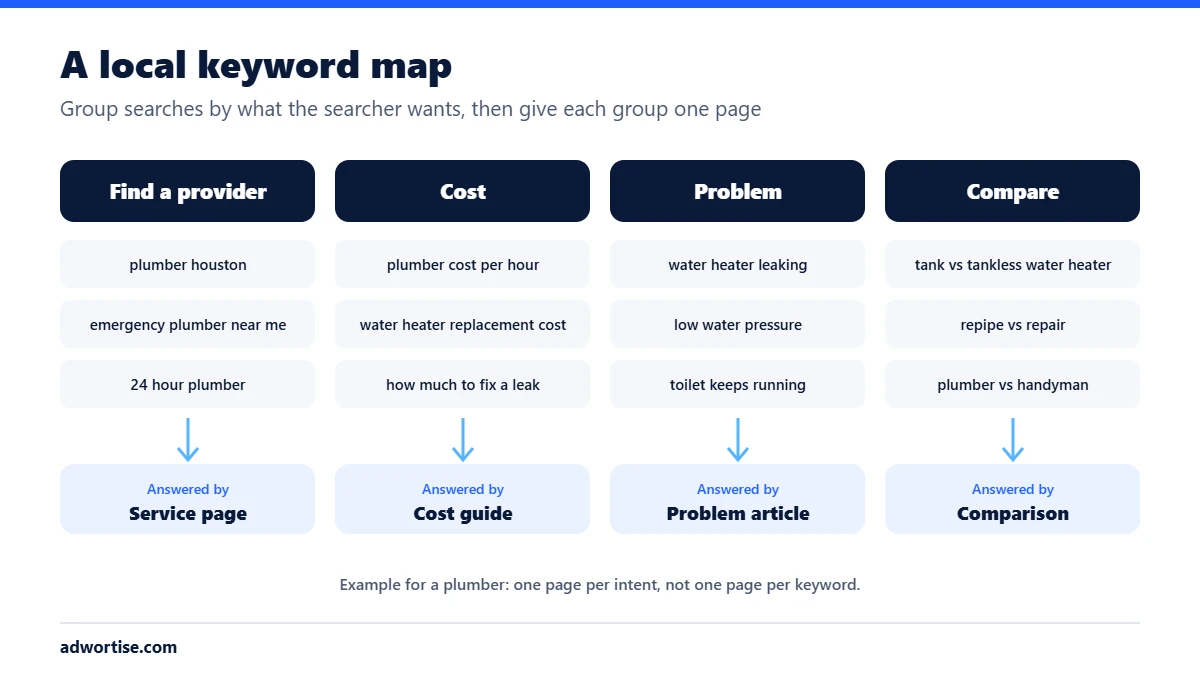
| Intent | What the searcher wants | Typical words | Page that answers it |
|---|---|---|---|
| Find a provider | Someone to do the job now | [service] [city], near me, emergency, 24 hour, best | Service page, and an area page where you really work |
| Cost | A price before calling | cost, price, how much, rates | Cost guide |
| Problem | To understand what is wrong | leaking, not working, noise, why | Problem article that ends with when to call a pro |
| Compare | To choose between options | vs, or, best type, which | Comparison guide |
How do you do local keyword research?
- List your services and areas. Write down every service you want more of and every town or district you really serve. This limits the research to work you want.
- Start with your own data. In Search Console, open Performance and look at the queries that already bring impressions. They show how customers phrase things and which pages Google already connects to them.
- Add what customers say. Read call notes, emails and reviews. The words customers use, such as “boiler making a banging noise”, are often the searches competitors miss.
- Expand with Google itself. Type each service into Google and note the autocomplete suggestions, the People also ask questions and the related searches at the bottom of the page.
- Check demand and difficulty. Use Google Keyword Planner, or a tool such as Semrush or Ahrefs, for monthly volume, difficulty and cost per click. Our data for 30 US cities shows how much these vary by city.
- Group by intent. Put searches that want the same answer in one group. “plumber houston”, “houston plumbers” and “plumber in houston tx” are one group and one page.
- Assign one page per group. Map each group to an existing page or a new one. Two pages for one group compete with each other, which is keyword cannibalization.
- Prioritize. Start with groups that are close to the money and realistic to rank for: high intent, lower difficulty, and services you most want to sell.
Should you target “near me” keywords?
Not by writing “near me” into the page. Google already reads a near me search as local and uses the searcher’s location. What wins those searches is the map pack and a page that clearly states the service and the area: a well-kept Business Profile, a correct address or service area, and a service page that names the place.
How many area pages should a local business have?
Only as many as you can make genuinely useful. An area page earns its place when you really work there and can say something specific: jobs done in that area, local reviews, local conditions, response times. Pages that differ only in the place name are doorway pages and can hold the whole site back.
What are the common local keyword research mistakes?
- Chasing the head term first. “plumber [big city]” is the hardest search in the market. Win the specific searches first.
- One page per keyword variant. Variants of one intent belong on one page.
- Ignoring problem and cost searches. They bring buyers early, before they have chosen who to call.
- Trusting volume alone. A search with 50 searches a month and high intent can be worth more than one with 5,000 and none.
- Researching once. Repeat the Search Console check every quarter. New queries show what to write next.
How does Adwortise do keyword research?
Adwortise builds a keyword map for every client before writing a page: the intents, the page that answers each, and the order to publish them in. It is the first deliverable in local SEO and SEO services, and the basis of the topical map.
Frequently asked questions
What is the best free tool for local keyword research?
Google Search Console for queries you already appear for, and Google Keyword Planner for volume estimates. Both are free.
Should I put the city name in every heading?
No. Use it where it reads naturally, in the title, the H1 and the opening sentence. Repeating it in every heading reads as stuffing.
How many keywords should one page target?
One intent. That intent may cover dozens of phrasings, and a good page ranks for all of them.
Do keywords with zero volume matter?
Often yes. Tools miss many specific local searches. If customers ask the question, it is worth answering.