
How does Google rank businesses in the local pack?
Google ranks the local pack on three factors: relevance, distance and prominence. You control two of them, and this guide shows what to change in each, with a Business Profile checklist.
Key points
- Google ranks the local pack on three factors: relevance, distance and prominence.
- You control relevance and prominence. Distance depends on where the searcher is.
- The primary category is the single most important relevance setting in a Business Profile.
- Reviews, links and consistent business details across the web build prominence.
- Google does not sell better local rankings. There is no way to pay for a higher map position.
What is the Google local pack?
The local pack is the box of three businesses with a map that Google shows for searches with local intent, such as plumber near me or dentist in Austin. Each listing comes from a Google Business Profile, and the same ranking decides the order of businesses in Google Maps.
For a service business, the local pack often sits above the ordinary search results, so a place in it can bring more calls than a first-page organic ranking.
How does Google rank businesses in the local pack?
Google ranks local results on three factors, and it combines them for every search. Relevance is how well a Business Profile matches what someone is searching for. Distance is how far each business is from the searcher, or from the location named in the search. Prominence is how well known the business is.
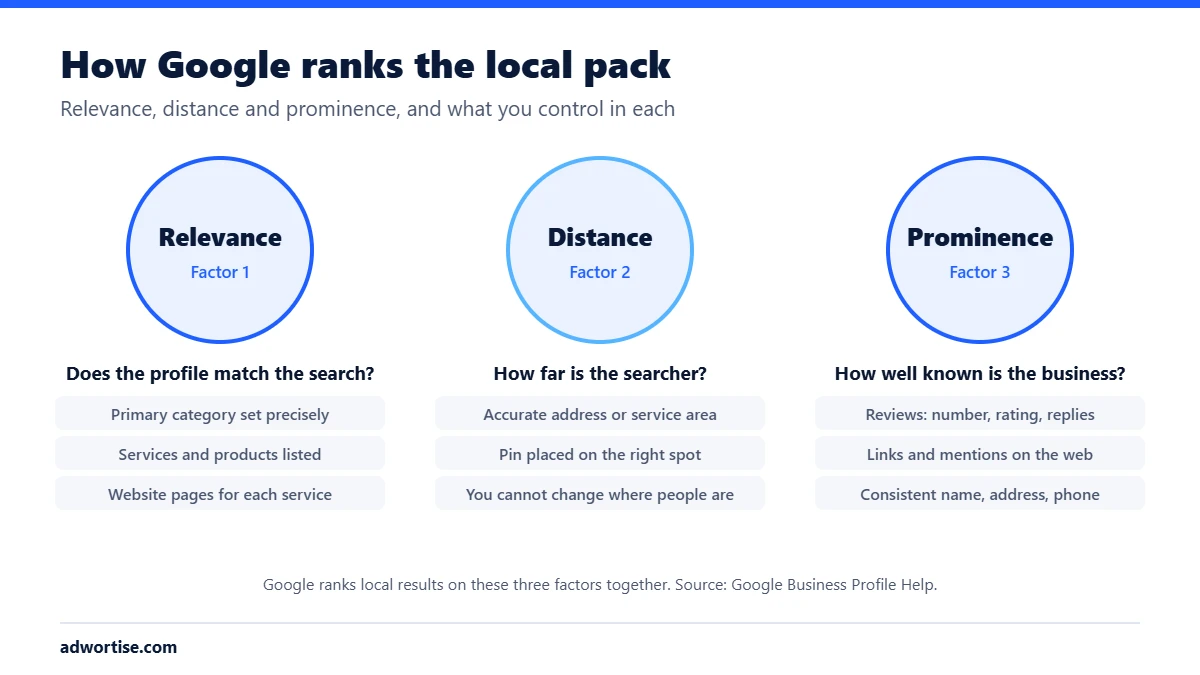
Because the factors are combined, a business farther away can outrank a nearer one if it is clearly more relevant and better known. This is also why the local pack looks different from one street to the next: distance changes with every searcher.
How do you improve relevance?
Improve relevance by making the profile describe exactly what you do, in the words customers search for.
- Primary category. Choose the most specific category that describes the core business, such as Emergency plumber or Cosmetic dentist rather than a broad parent. Add secondary categories only for services you really provide.
- Services and products. List each service with a short description. These help Google match the profile to searches that name a service.
- Business description. Say what you do, where and for whom, in plain language.
- Website pages. Link the profile to a site with one page per service. The website is part of how Google understands what the business offers. See semantic SEO for how to plan those pages.
- Business name. Use your real business name. Adding keywords or locations to it breaks Google’s guidelines and can get the profile suspended.
What can you do about distance?
You cannot change where searchers are, but you can make sure Google knows exactly where you are and what area you serve.
- Check that the address and the map pin are correct.
- If you visit customers and do not serve them at your address, hide the address and set a service area instead.
- Do not create profiles at addresses where you have no real, staffed location. Virtual offices and extra profiles for the same business break Google’s guidelines.
- For towns you serve but are not located in, a well-ranked website page about that area can reach searchers the map pack will not. Keep each page specific, or it becomes a doorway page.
How do you build prominence?
Prominence is built off the profile as much as on it. Google bases it on information from across the web, including links, articles and directories, and says that review count and rating are part of local ranking.
- Ask every happy customer for a review. Send the review link by text or email the same day the job is finished. A steady flow beats a burst.
- Reply to every review. Thank the positive ones and answer the negative ones calmly with what you will do. Replies show customers, and Google, that the business is active.
- Keep your name, address and phone identical everywhere. The website, Business Profile, directories, social profiles and industry listings should all show the same details.
- Earn local links and mentions. Local news, sponsorships, suppliers, trade associations and chambers of commerce are the most relevant sources. See link building.
- Strengthen the website. Google says a business’s position in web results also counts toward prominence, so organic SEO and local SEO support each other.
What should a Google Business Profile checklist include?
| Item | What good looks like | Factor |
|---|---|---|
| Verification | Profile verified and owned by the business, not a former agency | All |
| Primary category | The most specific category for the core service | Relevance |
| Services | Every real service listed with a description | Relevance |
| Address or service area | Correct pin, or a service area for businesses that travel to customers | Distance |
| Hours | Regular and holiday hours kept up to date | Relevance |
| Photos | Real photos of the team, vehicles, premises and finished work | Prominence |
| Reviews | A steady flow of new reviews, each one answered | Prominence |
| Website link | Links to the matching page, with the same name, address and phone | Relevance and prominence |
What are the common local SEO mistakes?
- Duplicate profiles. Two profiles for one location split reviews and can both be suppressed. Merge or remove the extra one.
- Keyword-stuffed business names. They may work for a while, then get the profile suspended.
- Different phone numbers in different places. Tracking numbers are fine on ads, but the main listings should agree.
- Buying reviews or reviewing yourself. Google removes fake reviews and can restrict the profile.
- Setting it up once and leaving it. Hours change, services change, and reviews keep arriving. A profile needs regular care.
How does Adwortise approach local SEO?
Adwortise works on all three factors together: the Business Profile and its categories for relevance, the address and service area for distance, and reviews, citations, local links and the website for prominence. See local SEO services, or the city data on pages such as Houston for how competitive local search is in your market.
Frequently asked questions
Can I pay Google to rank higher in the map pack?
No. Google says there is no way to request or pay for a better local ranking. Local Services Ads and Google Ads can appear above the map, but they are labeled as ads.
How long does local SEO take?
Fixes to the profile, such as the category, can show within weeks. Prominence from reviews and links builds over months.
Do I need a physical address to appear in the local pack?
You need a real location or a real service area. Businesses that travel to customers can hide their address and list a service area instead.
Do review keywords help ranking?
Ask customers to describe the work in their own words. Asking them to include particular keywords makes reviews look staged and can break Google’s review policies.