
What is Google Ads Quality Score, and how do you improve it?
Quality Score is a 1 to 10 rating for each keyword, built from three parts: expected click-through rate, ad relevance and landing page experience. It is a diagnostic, but what it measures shapes what you pay.
Key points
- Quality Score is a 1 to 10 rating Google gives each keyword in a Search campaign.
- It has three parts: expected click-through rate, ad relevance and landing page experience.
- Google says Quality Score is a diagnostic tool and not an input to the ad auction.
- The things it measures do affect what you pay, because ad and landing page quality feed into Ad Rank.
- Fix the component rated below average first, starting with the keywords that spend the most.
What is Google Ads Quality Score?
Quality Score is a rating from 1 to 10 that Google Ads gives each keyword, showing how your ads compare with other advertisers’ ads for the same searches. A higher score means your ad and landing page are more relevant and useful to people who search for that keyword.
You can see it in the keywords report by adding the Quality Score columns. Keywords with too little traffic show a dash instead of a number.
What are the three parts of Quality Score?
Quality Score combines three ratings. Each one is marked above average, average or below average, compared with other advertisers whose ads showed for exactly the same search over the last 90 days.
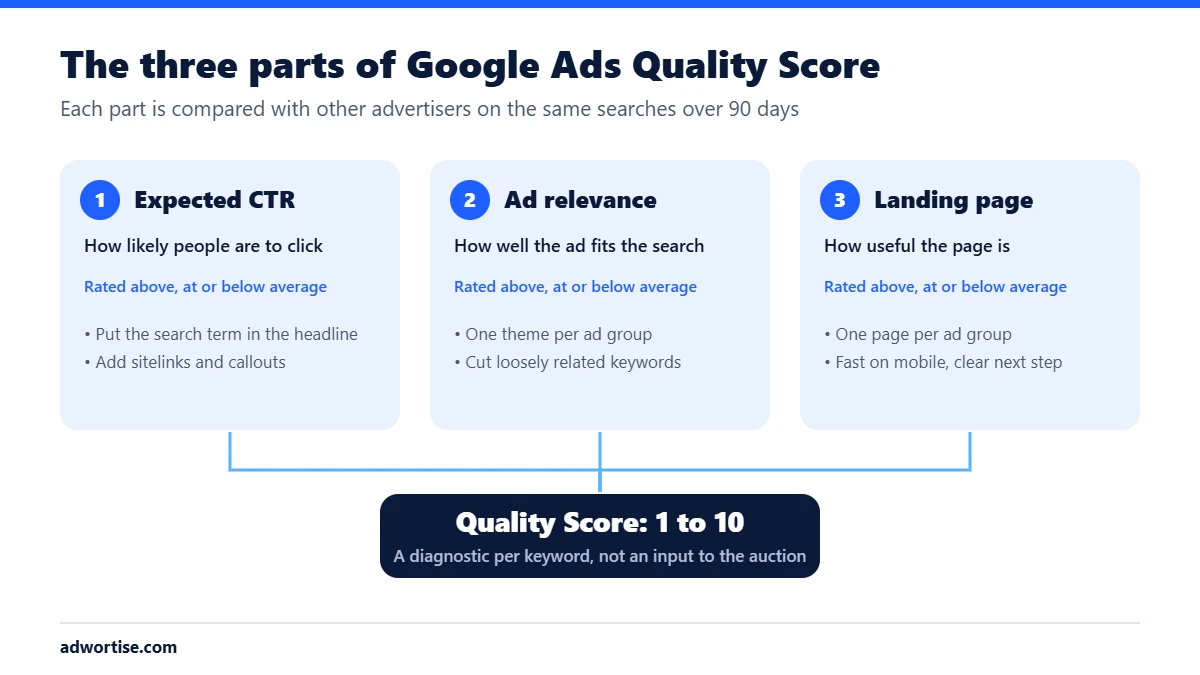
| Component | What it measures | What usually fixes it |
|---|---|---|
| Expected click-through rate | How likely people are to click your ad when it shows | Headlines that repeat the search, a clear offer, sitelinks and callouts |
| Ad relevance | How closely your ad matches the intent behind the search | Smaller, tightly themed ad groups and ads written for each one |
| Landing page experience | How relevant and useful the page is after the click | A page about the exact service, fast on mobile, with an obvious next step |
Does Quality Score affect what you pay?
Not directly. Google describes Quality Score as a diagnostic tool and says it is not an input to the ad auction. What does count is the quality of your ad and landing page at the moment of each search, which Google uses with your bid to calculate Ad Rank.
Quality Score is a summary of how that quality has looked over time. So a keyword with a low score is a warning sign: the same weaknesses are probably costing you position or pushing up your cost per click in the auctions themselves. Read more on how click prices are set in how much Google Ads costs.
How do you improve Quality Score?
Improve Quality Score by fixing the component rated below average, one keyword group at a time, starting with the keywords that spend the most.
- Sort keywords by cost. A low score on a keyword that spends $5 a month does not matter. Start with the top 20 by spend.
- Read the three component ratings. The keyword’s overall score tells you there is a problem. The components tell you which one.
- If expected CTR is below average: rewrite headlines to include the search term and the main benefit, test a second ad, and add sitelinks, callouts and call assets.
- If ad relevance is below average: split the ad group. A group with “emergency plumber” and “bathroom remodel” in it cannot have one ad that fits both.
- If landing page experience is below average: send the ad group to a page about that exact service, cut the load time on mobile and put the form or phone number near the top. See landing page optimization.
- Remove keywords that do not fit. Pause keywords that keep a below-average rating after these changes and bring little value.
- Check again after a few weeks. The ratings are based on the last 90 days, so changes show gradually.
What does a fix look like in practice?
Take an HVAC company with one ad group called “AC services” that holds the keywords AC repair, AC installation and AC maintenance, and sends every click to the home page.
- Before: one generic ad, “Trusted HVAC Company”, shown for all three searches. Ad relevance and landing page experience are both likely to be below average, because neither the ad nor the page matches any one search.
- After: three ad groups, one per service. Each has an ad that names the service in the headline and links to that service’s page. The repair group’s page leads with same-day booking; the installation page leads with the system types and a quote form.
Nothing about the bid changed. The ads now match the searches, and the pages match the ads, which is exactly what the three components measure.
What are the common Quality Score mistakes?
- Chasing a 10 on every keyword. Quality Score is a guide, not the goal. Cost per lead is the goal.
- Judging the account by its average score. An average weighted towards cheap keywords hides problems on expensive ones.
- Sending every ad to the home page. It is the most common cause of a below-average landing page rating.
- Huge ad groups. Dozens of loosely related keywords in one group make relevant ads impossible.
- Ignoring speed on mobile. Most local searches happen on phones, and a slow page costs clicks before it loads.
How does Adwortise use Quality Score?
Adwortise reads Quality Score components in every PPC audit to find which ad groups and landing pages are losing money, then rebuilds them into tightly themed groups with matching pages. It is one input to the target cost per lead that each Google Ads management account is run to.
Frequently asked questions
What is a good Quality Score?
A score of 7 or higher usually means the ad, keyword and landing page fit well. More useful than the number is whether any of the three components is below average.
Why does my keyword show no Quality Score?
Google needs enough searches for that exact keyword to compare your ad with others. Keywords with little traffic show a dash.
How long does it take for Quality Score to change?
The ratings look back over 90 days, so improvements show over several weeks rather than overnight.
Does Quality Score apply to Performance Max or Display campaigns?
No. Quality Score is reported for keywords in Search campaigns.